Sunday, October 20, 2013

Blog Post 9


Brian Crosby has a 4th grade class that will be enrolled in his class for the next three years (grades 4, 5, 6). Over 90 percent of his students are second language learners. At the beginning of the school year, Crosby took a survey of his students’ knowledge in his class. Most of the students weren’t able to give basic demographic information.

There is a disconnection between students and learning because of a narrow curriculum.  However, students only know a narrow curriculum.  They have only been taught in a lecture style. Students don’t have any experience or input to build schema for the world. It is hard for them to imagine if they don’t know how to do this. As teachers, if we don’t have imagination or creativity then where would the students passion stem from?

Crosby took a narrow curriculum and enhanced it to 21st century learning. A hands on activity that he and his students did with the hot air balloon covered standards that the students needed to know and gave them experience on how air pressure and other things work. After the activity was done, the students embedded videos and summaries about the activity and why the reaction was the way it was on their blog.

Crosby explains that active learning empowers students to learn own their own. It allows them to connect with others, collaborate with classmates, and include thoughts and ideas during activities.  Brian Crosby changed his 4th grade class by doing things that attract their attention. His class went from not knowing their basic demographic information to illustrating science projects to other students in a different country. Crosby’s class is the perfect example of innovative learning.


Paul Andersen: Blended Learning Cycle


In this video, Paul Andersen who is a high school AP biology teacher, is explaining a system he uses within his class. Mr. Andersen uses a strategy known as the blended learning cycle. The strategy is combining mobile, online, and classroom learning. There are six parts to this learning cycle. The first one is a question. This is also known as the hook to get them interested in the topic. The next step is investigation/inquiry. Then they have a video of instruction. This frees up some of Mr. Andersen's time and the students are able to review the videos when they do not understand. The next step is elaboration which goes into the explanation of the answer to the question originally asked. Then he reviews with the students. He meets with the students individually or in small groups to ask them questions to check their understanding. This also gives the students the opportunity to ask him questions if they are having trouble understanding. The last step is a summary quiz which is about what they had just covered. He will not give them the quiz if he can tell that they do not have a good understanding of the subject. If they do not do well on the quiz then he makes them start the process over.

We think that this strategy is a great idea. We think the first step is extremely important because it gets the students interested in the topic. The investigation step is important because the students need to find the answer out for themselves. They are more likely to remember the information more if they find it out on their own. The video gives the students more insight about the topic at hand. The review stage is especially important because it gives the teacher the opportunity to evaluate if the students are ready to take the summary quiz. We think that it is good that he gives the students the chance to go back and learn the information again if they did not get it the first time.


In this video, Mark Church, co-author of the book Making Thinking Visible, describes a little bit about a lesson he does in his 6th grade classroom with this students. This lesson is the “headlines routine.” The students are going to work in groups to do a project on a video they had watched the day before in class on early human beginnings and the origins of society. He will have the students talk about the puzzles and video their groups and come up with a short headline to tell what it is really all about. He gave each group a long thick sheet of paper to write their headline on after their discussion. After every group had completed their headline they shared them in front of the class. The students needed to have just a little bit to back up why they chose this as their headline. After doing the same unit for two more weeks, Mr. Church will ask the students what is the headline now since they have learned a lot more and things have changed since the beginning to when they are doing their final projects.

We think this would be a great idea to use in the classroom. This would work especially well for long projects like the one in the video. This engages the students in thinking about what they already know, or what they think they know in the beginning. This also allows the students to stay interested in the assignment and continue to learn and change the headline as time goes on and they learn more about the specific unit.

Sunday, October 13, 2013

C4T #3 and #4

C4T #3

The Lasting Legacy of “The Red Group
Different Groups of People
In this blog post vice principal, Erin Paynter, tells about watching a little girl chose colors because of the group she was in school. She wanted to use the red color pencil and give her brother a green. Now we would assume that the colors are based on skill. She emphasizes that as teachers we need to be careful in how we group students and not to confine them to just one group for a long period of time.

In my comment I said that this story makes me realize that as a future teacher I need to keep in mind to change up the groups within my classroom. I do believe that it is important to have groups within the classroom but the students should not be confined to just one group. Students should be given the opportunity to work with everyone in the class. Thank you so much for sharing.

C4T #4

My Back-to-School Letter to My New School #SAVMP
I was assinged to Erin Paynter again. Ms. Paynter has not posted any new post. This post was the most recent before the Lasting Legancy of "The Red Group." In this post she is giving an update that she has recently become a part of an on-line mentoring project called School Admin Virtual Mentor Program. She posted a letter that was sent out to the families of her students. In this letter she introduces herself and expresses her passion for the students education. She also discusses something she refers to as the 6 C's: Creativity, Critical-Thinking, Communication, Collaboration, Character and Community. She wants to shift how the teachers are teaching. She said " the process of learning is the goal, not the content of learning."

In my comment I said I really enjoyed her post and could that she portrayed her passion for the students education and her own learning. I also said that communicating with the community is vital. The letter did a wonderful job at at informing the community of what you expect out of the school year. I thanked her for sharing.

Blog Post 8

Why I Flipped my Classroom by Katie Gimbar
Dr. Lodge McCammon's FIZZ - Flipping the Classroom

Katie Gimbar and Dr. Lodge McCammon both have made videos on what flipping the classroom means. In the videos they discuss how before flipping the classroom teachers spend ninety percent of class time on lecture. When a teacher flips the classroom, they provide students with videos and activities that cover the lesson that would normally be taught in the classroom.Once the students are in the class they work on the lesson they have already learned. After flipping the classroom, the teacher can focus on each students need and what part of the lesson they did not understand. Giving the students the videos that explain the lesson gives them the opportunity to re-watch the video if they do not understand it the first time. Before flipping the classroom, the students only had one chance to understand it because once they teacher explains it and then moves on. This is a good concept but could be difficult in the beginning.

Pearl Diver
Summarized by: Chelsea Calvert

Cutting the eel picture


This is an app that covers number and operation standards. Since iPads are becoming more common in the classroom this is a tool that could easy be accessed. This app helps the students understand how numbers are represented and the number system. The students must understand and know how to represent fractions on a number line. This game is more geared toward grades third through eighth. I chose this tool because it is something that will keep the students engaged. The students can also move into harder levels as they learn more so they are not confined to the same problems. If the teacher was to cover fractions and their place on the number line, they could let the students play this app to practice and check their understanding.


Summarized by: Keri Brown
Spelling City is a website and also has an app for iPads other devices. This app has a feature to search the language arts standards correlation list for standards by region and grade. This app provides correlations to U.S. Standards by State, Common Core Standards for each State's Implementation, Australian Standards by State, Canadian Standards by Province, and English National Curriculum Standards. This is a great tool for teachers to work with students in the classrooms as well as at home on their own time for homework or extra help. There are many games provided on this site for parts of speech, nouns, synonyms, contractions, phonics, Dolch-sight words, as well as vocabulary activities. There are also premium membership opportunities depending on how many students you have. There are many benefits with the premium membership such as, student activities being tracked, student test results and activities are automatically recorded, and you can create customized lists and lessons to meet each student's individual needs. This makes it great for ESE, ESL/ELL, and RTI.


21st Century Learning is Here!
Summarized by: KeNesha Brown
the brain one side consist of fun the other side consist of work

Mark Stevens explains how the technology people use in their daily life influences how students learn. Students and teachers have changed, and learning has changed, as well. However, the former setting of a school remains the same over the last 100 years. Stevens states, "We live with the reality that the same structure of brick, mortar, and steel will continue to greet us each morning" (Stevens). The great thing about 21st century learning is it can take place anywhere. Stevens explains that learning environment is not about the cool gismos and gadgets that are being used but the teacher applies today's technologies to make materials for students more engaging. "In other words, encourage the students to create, communicate, and collaborate in many ways" (Stevens).

"Learning in the 21st century takes new thinking" stated by NEA Executive Director John I. Wilson. 21st century skills are required in order for teachers to prepare their students for the globalized workforce. The teachers should find ways to incorporate technology while fulfilling the requirements for the curriculum. There are many useful tools that are available for teachers.

Gismo Gadget

The question that Stevens mentions is "what does this 21st classroom look like?" He explains that interactive demonstration allows students to work through materials together. In addition, having access to the internet allows students to engage and transform content from around the world through tests and reliable learning portals. Students should have pens that records audio and data, because it helps students learn organization skills and allow teachers to share notes easily. Also, Stevens states that mobile devices allow students to learn on the go. Moreover, web-based applications allow teachers, students, and parents to stay connected outside the classroom.

The question is where do we start from here? Stevens explains that all teachers must think through the entire learning experience that they are creating for their students. Stevens provides NEA's and SETDA's key questions to inspire teachers thinking on how they can incorporate technology this school year:
gold man sitting on world

-What tools and technologies will help the students create, collaborate, and communicate better?
-How can teachers let students learn with technology they already have?
-What is the appropriate role of the web, social media, mobile technologies, interactive white-board, etc., in today's classrooms?

Mark Stevens made some great points on 21st century learning. Teachers should consider ways to incorporate technology in their classrooms. These generations of students that educators are up against are more advance. Every moment of their lives is evolved around some form of technology. Educators must enhance their lesson plan to keep the attention of their students and cover all of the state standards. The main focus of the teachers' lesson should be allowing students' interest be the guidance to their learning process.

From reading Mark Stevens article, I did a search on tools to use to incorporate technology in students learning process. The website I can across is called BrainPop. BrainPop is a great tool to use as an inside or outside source in the classroom. It provides students with videos and games on any subject and topic. BrainPop is a tool that I would use to make sure my students are using technology as a tool of learning.

Project 9

Sunday, October 6, 2013

C4K September

C4K #1
This week I was assigned to comment on Lynn's blog. Lynn was assigned to write a paper about something she believed in. Lynn believes in great trusting relationships. She had to give a personal example of why she believed this. She wrote about the relationship she is in now. She described their relationship and how they trust each other.

I told her that after reading her blog it was clear that she really believed in a trusting relationship. I said that it is great that her boyfriend and her can trust each other. I also said that this blog can be related to many people because we all want to have trusting relationships with other people. I told her that this was a well written blog and she addressed the topic well.

C4K #2
This week I was assigned to comment on Shirley's blog. Shirley did a video on place value. In the video, she is holding up a sign with a problem on it. She goes step by step on how to add the numbers. Once she has added the numbers she says sum of the two numbers.

In my comment, I told her she did an awesome job of explaining how to add the two numbers and she should keep up the good work.

C4K #3
This week I was assigned to comment on Johnlee's blog. Jonhlee did a presentation about camping. He gave examples of things that you would need to bring to be prepared for camping. He also gave examples of things someone would need to be aware of such as possums. He included pictures on every slide.
I told him that his presentation was very informative about camping. I also said I liked how he used pictures within his presentation. I told him he did have a few spelling errors but overall he did a great job.

C4K #4
This week I was assigned to comment on sixth grader Cody's blog. Cody answered the question how much does the sky weigh. He said that the sky weighs nothing but that the atmosphere weighs five billion pounds. So in a way the sky does weigh something.

In my comment, I told him that I have learned something new. I never really thought about the weight sky but now I know that it is the atmosphere that weighs something. I said that he did a great job at answering the question.

Blog Post 7

Project Based Learning Part 1

This video is a conversation between Dr. Strange and Anthony Capps about Capps experiences as a third grade teacher. Anthony Capps looks at projected based learning as not only a means to show that the student has achieved something but also a means to get the students to learn something. The goal of a good project is to have an authentic audience, have student interests in mind, and have it involve the community some how. If the student have an authentic audience they push themselves more to do their best work. If they are given the opportunity to show their work off they are also rewarded not with just a good grade but by the audience. Having students interest in mind while making the goal for projects is important because we need to select things that will keep them engaged. Being able to involve the community somehow within projects that occur in the classroom is important because then the student can see how it relates to their life outside the classroom. As an example, Anthony Capps has his student write a letter to their congress man , Joe Bonner, to address the issue that women are now allowed to fight in open combat. Capps used this topic to tie into their reading which was about equality and cultures. Capps was also about to meet the reading, writing and history standards required by the AARS. Once the students were done writing their letters, Capps had them peer edit and revise each others. After all of the revisions were made the student picked the top eight that would be sent to their congress man. The students were okay with picking these letters because they felt as if it was representing them as a whole and not just the individuals that wrote them.

After watching this video I have learned that is can be come what easy to incorporate project based learning in the classroom. I learned some goals to set when making a good project. I have also learned that these projects can meet multiple standards that are required for the students to learn. This type of project also let the students learn how to revise and critic each others work which is also very important. Involving the community plays a major role in these projects. When you do incorporate the community the students not only learn the information but they also learn how to put it in the context of their everyday lives.

Project Based Learning Part 2

This video is also a conversation between Dr. Strange and Anthony Capps about Capp's experiences as a third grade teacher. Anthony Capps tells Dr. Strange about two different projects that had some difficulties. The first project was about the students researching what it would be like to be a child in Afghanistan. The student were to make a movie about it and include pictures. He was shocked at how the students came up with their own questions to answer. Some of them focused on specific things like religion, fashion, warfare and farming. One of his students was not allowed to participate in this project because his father had served in Afghanistan and did not quite agree with his son learning about the culture. Mr. Capps gave him an alternate assignment which he did well on. As teachers, we need to be prepared for thing like this. We need to have alternate assignments in place just in case if the parents do not agree with the project the students are assigned.

iCurio


In this video, Dr. Strange asks Anthony Capps what iCurio is and how he uses it within his classroom. Capps describes iCurio as a tool that has filtered information that students can use. Students can safely search for things like pictures, videos and websites on iCurio. iCurio is a search engine for audio and video around subjects that fit into the Common Core Standards. The students are given a login for iCurio and can search things by themselves. iCurio supplies the students with storage capacity. Not only can teachers store things but so can the students. If the students find something interesting or relevant to their topic they are searching they can save it to their account. This gives the students the practice to learn how to be organized. iCurio also has a directory for historical figures. This is a great tool because it makes it easier for the students to find who they are looking for. The students can type in a generic search into this directory and iCurio will find the people that fit the description. iCurio is great for all grade levels and can give the teacher comfort in knowing the students are using a safe site to find information. iCurio also has a read aloud feature which can be great for ELL students, blind students or if the student has a learning disability.

Discovery Ed


In this video, Dr. Strange is asking Anthony Capps what is Discovery Ed and is it a useful tool. Capps refers to the saying "A picture is worth a thousand words" and he says then "A video must be worth a million." Capps lets his a students search on Discovery Ed to find videos about the topic they are discussing such as plants. Capps describes Discovery Ed as a tool that brings experts into the classroom. Providing a video to go along with text is a great way to get the students to retain more about the topic. Capps allows his students to make videos within the classroom. Capps says the students like reading just as much as making the videos. Discovery Ed is a great tool to use because it can provide the student with a source other than their teacher to learn from.

The Anthony - Strange list of Tips for Teachers Part 1
Summarized by: Chelsea Calvert

In this video Dr. Strange and Anthony Capps are creating a list of things that consists of things that as teachers we should do. They make a list of four things that teachers should do. Teachers need to be lifelong learners. To prepare ourselves to get into the teaching field we need to be extremely interested in learning. We need to be constantly learning and modeling how to learn. Teaching is hard work and even after you leave your classroom you should still be seeking to learn new information. Learning how to teach should be a teacher’s hobby and part of their everyday lives. It can be very rewarding once you have learned something new that you can incorporate within your classroom. Teacher need to be flexible and creative. As teachers, we need to be prepared for surprises that might arise in the classroom. We need to be prepared to go outside the normal routine if something were to come up. Teachers should also reflect on their work. We need to be able to critic ourselves to master teaching. These four things are all important tasks that teachers need to focus on.

Don’t Teach Tech - Use It
Summarized by: Keri Brown

Anthony starts off by explaining that whether we like it or not we use technology every day. He states “we’re immersed in it whether you want to be or not, you can’t buy groceries without it.” Anthony says that technology is natural for kids whether they are in low-income areas or high-income areas, technology is a part of their lives. When creating your lessons, you should scaffold technology into those plans. Anthony says that you should focus on one technology at a time and make sure your students have different opportunities to review and continue practicing and using each technology. Once students have practice with a technology tool you can then add on and incorporate the use of other technology. Anthony uses iMovie with his third graders and he says that by allowing them to use iMovie they can be creative, express themselves, it is free, it is clean, and the students love it. You should use technology in your classroom to allow your students to get excited about what they are doing, use it to let them share what they are doing, and scaffold it to let them use one tool at a time then progressively add in more tools. Do not expect perfection from your students, because it is not going to happen. Students will make mistakes, but as a teacher you should allow time to reflect on those mistakes so they can better themselves the next time they use this technology. Dr. Strange states “you don’t have to worry about spending a great deal of time or energy teaching your kids how to use technology, just give them the opportunity, and don’t expect perfect.” As the teacher, you should “do it first.” Use the technology and do the projects to better understand why students are asking questions and how you can help them.

Additional Thoughts About the Lesson
Summarized by: Kenesha Brown

Anthony Capps explains that “a lesson is four layers thick.” When teachers are preparing their lessons, there are four things to think about. The first layer is think about the lesson in terms of the year. Teachers should think about how are they going to cover the content standards and have the curriculum they prepared covers all of the standards. The next layers is unit. There are layers within unit that create the rest of the four layers to an effective lesson. Teacher should consider unfolding a unit in a way “that is meaningful and that is connected in some type of way.” The unit should be a stairwell of goals that teachers want their students to meet. “Stretch out a unit by saying we going to start the unit off with this and by the end of the unit the student should be able to do this.” The unit then moves down to the week. Teachers should think about their goal on a week scale. They will need to try to figure out how everything is going to get done. Most importantly, the final layer is the daily lesson. The daily lesson is the way teachers get students’ attention. It is the hook to what they can expect to do. It is also the way teachers can evaluate students learning.

Project 2: 1st Progress Report


My Personal Learning Network
I choose to use Symbaloo to form my Personal Learning Network. For my personal learning network, I put the websites I most frequently visit and some learning websites I viewed from this class. In the top left corner I put things like Google and the weather together. In the top left, I put sites like Facebook, Twitter, Pinterest, and links to my emails. On the bottom left I have put sites like Flickr. In the bottom right, I selected sites such as the EDM blog, the instruction manual and USA home page. I think this is a great tool for everyone to have because it makes navigating through the internet easy. I feel that my future students will be able to create and use PLNs in the classroom and at home.

Project 13

Our Google site: Lesson Plan #1
By: Chelsea Calvert, Kenesha Brown, Keri Brown


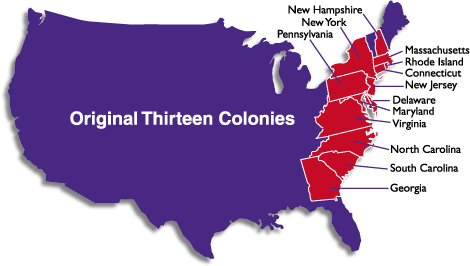
This lesson plan is for fifth grade students that will last for two weeks. The students will have to write a research paper about one of the thirteen colonies. The driving question for the paper is "What is colonization? Describe the colonization of North America." Before the students start their paper, they will get to play a trivia game on iCurio to see what they already know. Once the students have completed their paper, they will be paired up with another student who also as the same colony to form a presentation on Google. The students will have to compare what they found and decide what are the most important facts to include into their presentation. Once the groups have completed their presentations they will have to present them to the class. This lesson covers English Language Arts and Social Studies Common Core Standards.

Sunday, September 29, 2013

Blog Post 6

The Right Way to Ask Questions in a Classroom

Ben Johnson, a high school principal, explains that students get confused during class because the teachers act as if they have all of the answers then ask the students questions as if they nothing about the topic they just covered. As educators, we need to think about what we expect the students to learn during the questioning process. Teachers check the students understanding by asking "Does everyone understand?" but most of the time the students do not respond so the teacher assumes they can move forward. In reality, the students might think they understand but do not. Some students might be completely lost and do not know what to ask. As educators, we need to steer clear of this type of question because it is only telling the students this is your last opportunity to ask. Another element about this question is that it is just a yes or no question. It is easy to assume that all the teacher wants to hear is that everyone understands so the students will not say otherwise. This type of question is a close-ended and does not push the students to think more in detail about the topic. Mr. Johnson explains a simple but effective way to ask a question. The teacher will ask a question, pause for three seconds, then call on someone to answer the question. This requires every student to think of an answer. Teachers do need to be sure they do not choose the same person every time they ask a question.

Asking Questions to Improve Learning

According to teachingcenter.wustl.edu, when asking questions within your classroom can model a process the students should use themselves. When teachers are planning questions they need to keep in mind the course goals such as: core concepts and critical thinking skills. Teachers want to avoid asking "leading questions." These types of questions discourage the students to think on their own. Teachers always need to follow a yes or no question with an additional question. The teacher could simply ask why they said yes or no. In class discussions asking more than one question should be avoided because students could be confused about what is being asked. Aiming for direct, clear, specific questions so that the students can learn how to answer build depth about a subject by answering multiple questions. When planning lesson plans, teachers should make a note of when there is going to be a pause within the lesson to ask questions. When teachers ask questions throughout the lesson they are more likely to see more class participation. There are two types of questions that teachers should ask, close-ended and open-ended questions. Close-ended questions have a limited number of correct answers. Open-ended questions have multiple answers and encourage discussions and active learning.

Why ask open-ended questions?
Teachingcenter.wustl.edu has provided a list of objectives of why teacher should ask open-ended questions.
1. To assess learning.
2.To ask a student to clarify a vague comment.
3. To prompt students to explore attitudes, values, or feelings.
4. To prompt students to see a concept from another perspective.
5. To ask a student to refine a statement or idea.
6. To prompt students to support their assertions and interpretations.
7. To direct students to respond to one another.
8. To prompt students to investigate a thought process.
9. To ask students to predict possible outcomes.
10. To prompt students to connect and organize information.
11. To ask students to apply a principle or formula.
12. To ask students to illustrate a concept with an example.


As future teachers, we need to be aware of the two types of questions that are effective in the classroom. We need to prepare open-ended questions to be included within our lessons to encourage students to go into depth about the topic. We need to be sure to not ask more than one question at a time. When asking questions throughout the lesson, we are more likely to get more class participation and encourage all of the students to think about subject at hand.

Project 8

Sunday, September 15, 2013

C4T # 1 & 2

C4T #1

I got assigned to Hiedi Siwak blog. In her post she had visited another Germany to see how their schools function. She took many pictures but when she went it was during the summer time so the school was rearranging. She discussed how many different things the school taught the students such as things we would consider are taught at home. The school also allows the students to have some say so in a part of their daily schedule. The school offers the students many outside activities. She was sure to inform the reader that not all schools are like this. The school offered instruments to every student. If a students could not handle being in the school setting they school provided a room the students could go to and let out steam or just calm down.

In my comment I said that I enjoyed seeing how different schools can be. I also thought it was great that they offer the students a variety of things to learn such as cooking, painting and playing an instrument. I was glad she shared this experience for people to see how diverse a school can be.


C4T #2


In this blog post she describes "Maker Day." She got the students to bring in materials that were not much of a value. She wanted them to gather things to make something out of the items the students had brought in. She asked the students what the cookie tin jar in her hand was. Of course, the students responses were 'it is a cookie jar' she in return said "No, it is a wheel." By doing this the students started to think of other things the cookie jar could be. She got out the items the students brought in and had them take them apart and build something with them. The students for once were not given specific instructions and were given the freedom to use materials to build something. The students perspective on items that did not seem to mean a lot changed. They learned they can make whatever they want out of just about anything.

In my comment I thanked her for sharing about maker day. I also stated that this is a great way to get every student engaged in class. It also changed how the students perceived the classroom. For once, they were able to do things on their own without instruction from the teacher.


Project 3

Blog Post 4


Langwitches Blog 


I thought that recording was a great way to hear how much the students loved what they were doing. Even though one of the stories had Hebrewin it, it was amazing to listen to how excited the students were. I learned that getting them involved with podcasting makes them analyze how they read andhow to portray an emotion in how they read. They not only wanted to read andmake a podcast but they also enjoy listening to the stories that they have done. One of of the posts the teacher had the students make a podcast for the class blog. Giving the students an audience other than themselves gave them the incentive to be sure and put everything they had into it. In another post the teacher said she made sure to record the lines of the story out of order so she could let the students listen to each sentence and put the story in order. I think that this was a great idea because they had to focus and recall what happened throughout the story.

For my podcast I need to keep in mind that this is going to be posted for anyone to see. I want and need to do my best because anyone will be able to view it. I also learned that I need to think about how I will express emotion while recording a podcast. 

Sunday, September 8, 2013

Blog Post 3

Peer Edit With Perfection Tutorial 


I personally found that the power point was the most helpful resource. It not only defined peer editing but also gave a break down of all three steps. The slide show gave the reader examples on how to compliment and make suggestions  in a positive way. It also gave the reader a chance to practice each step such as giving compliments, suggestions, and corrections.

I think that peer editing can be very beneficial for both the student and the editor. At first I was a little unsure on how to correct someone else's work without coming off as being rude. After watching this slide show, I feel more comfortable about editing my peer's work because I know that it will be beneficial to the both of us. As a student need to become familiar with how to correct people's work in a positive way so when I do become a teacher I will have the experience in doing so. Having your work edited it always great because they could point out things that you had never noticed you were doing wrong. It is also good to get praise about your writing and see that what your peers are thinking about the same topic.

Sunday, September 1, 2013

Blog Post 2


Mr. Dancealot by Chelsea, Kenesha and Keri

In Mr. Dancealot’s video, he teaches a dance class with no hands-on experience. By using a PowerPoint, he has his students take notes and sit quietly during his lecture. When one student stood up to give the dance steps a try, he was instructed to have a seat. How can a dance teacher teach dance through lecture?

The truth is he can’t. Actually, nothing can be learned just through lecture. Students need to have hands-on experience in order to grasp the idea of anything.  It’s okay to explain the fundamental of how to do a particular assignments; however, students won’t get the concept unless they try it for themselves. Technology is growing in our society and it is becoming more and more important in our schools as well as our everyday lives. Hands on experience is necessary when learning how to use this technology instead of just a lecture or reading something out of a book. The information needs to be applied to be learned. The students in this video did not actually stand up and dance before their exam, which caused them to be very confused on the day of the exam.


Teaching in the 21st Century by Kevin Roberts <br/>
Summerized by Chelsea Calvert
This video by Roberts asks many questions to future teachers. He says that teaching is not the main source of knowledge anymore. He believes students should be taught skills not facts. He believes that students will be able to learn the information they are getting from a teacher from the internet. The students will be able to communicate from a variety of sites such as blogger, twitter, facebook, pinterest and many more. The students can also type the question they have into any search engine. If the students are able to find out everything thru the internet or by discussing it with each other, then why do they need teachers.  If his suggestions are true and accurate, teachers will become obsolete.
I agree that the student must be shown how to use the technological applications available to them. Teachers should be encouraging in any type of learning. Students need to form their own opinions and need to be able to find out the answers to questions they might ask themselves or a teacher. Students need to be taught responsibility and integrity. Teachers have an effect on every aspect of a students life. Teachers can be any one who teaches a student a life lesson. Students should be shown every possible form of technology and then allowed to study how they choose. However I do not believe that teachers could ever become obsolete.  


Summarize by: Kenesha Brown

Wendy Drexler explains what it would be like if students took control of their learning. She goes on telling a story about a student from 21st Century High. The student was assigned to do research on any topic. He chose American Psychology. However, there is no textbook for the class and the teacher hardly ever lectures. His teacher believes in connectivism, which is a theory that learning occurs by social networks and many diverse connections and ties. Connectivism are made up of many tools and technology. However, the question was asked “ Why does a network student need a teacher?”

Drexler  explains that the teacher empowers students to  take control of their learning and connect with new people who will strengthen the learning process. They teach students how to build their learning network. They also show them how to take advantage of opportunities. The teacher is there to be the learning architect when the students get lost. He/She serves as a learning concierge when the student gets stuck, as well as, teaching them how to be a network sherpa  when looking at resource. In addition, (s)he teaches them how to be a synthesizer when looking at information.

From viewing this video, network learning is something that the educational system is becoming. Students are being pushed to go out there, find resources, and look up information. As educators, we should allow them to spread their wings and find answers to their questions. Drexler explained the teacher’s role really well. Basically, teachers should allow the learning process to happen until they notice a student is unsure about something.  


Vicki Davis is a teacher in a rural city in south Georgia. Vicki has completely opened the minds of her students to many new ideas of technology. She has provided them with access to wikis, blogs, podcasts, virtual worlds, and other media tools. These students are constantly learning something new about technology. Everyday there are opportunities in the classroom for students to use technology with their classmates as well as others around the world on blogs or other resources.
As a teacher, Vicki does not spoon feed her students. In the video, she said that she often gives them unfamiliar words and tells them to look up the meaning of the word in the context in which she has used it. Vicki also was partners in a founding a global collaborative project. “Digi Teen,” which is digital citizenship for teenagers. On Digi Teen, students from around the world studied digital citizenship by researching, writing, and posting their work through two digital portals. Vicki also believes that she is constantly learning from her students and that they can learn from each other as well, therefore she has specific times in her class where each student will be the teacher, or certain groups will teach on certain days.
The Edutopia website is full of resources for teachers. There are links for student engagement in the classroom and tips for keeping the students involved. There are also links to other blogs from teachers with experience in the classroom setting. Also on the website, there is a spot you can go to search things specific to each grade-level which can be a very useful tool for teachers. At the bottom of the webpage, there are links to “get inspired,” “find solutions” to problems or issues in the classroom or school, and “join the conversation” by getting connected with fellow educators on social media.  

Sunday, August 25, 2013

Blog Post #1


Krissy Venosdale's: Venspired

Krissy Venosdale is a teacher who decided to start blogging about her teaching and her ideas. She did this to not only share her ideas but also to gain some by communicating with other educators. Her main goal is for the students to want to be creative and eager to learn. Her students inspire her with a new ideas every day. She designs her classrooms with different themes every year. She makes sure to teach the students teamwork and she makes them display this in her class daily. She believes that she should students "not what to think but how to think." Ms. Vensodale writes a post about the kind of school she would build if she was given the opportunity to build a school. She would make sure the school is up to date on today's technology and it would be used every day. She also would focus the school on creativity and have the school painted with vibrant colors. She also would make the cafeteria where the students would enjoy going to it almost like a lounge. The students would be able to have conversations with people that have professional careers. She is a person that is extremely interested in science so every lab would be equipped with the necessary supplies for the students to do experiments regularly. Grade levels would not be based on age but on their readiness and abilities.


Sugata Mitra TED Talk 2013 

Sugata Mirta is a man who use to teach people how to write processors. Near his work was a low income neighborhood which he wondered how those children where ever going  be people that learned how to write the processors if they are never exposed to a computer. He formed what he is called a "hole in the wall." At his office building he made a whole in the wall and set the computer in it so that the neighborhood children could investigate. He realized that after a while the children had figured out how to use it on their own. He set up computers in different countries with the language set on English and the children still managed to learn not only the language but the information that was on the computer.  Mirta downloaded information about DNA and gave this information to the students thinking it was impossible for them to ever learn. After two months he tested them and they scored a thirty percent. Since he could not send a teacher down to where they were he found someone to just sit behind the students and encourage them. After another two months he went back and retested them and they scored fifty percent. He noticed that the students teach each other how to read the information and how to function the computer. Mirta is trying to build a self oragnized learing environment. He believes that the classrooms should now have broadband plus the ability to collaborate and enouragement. Before he did this experiment with the "hole in the wall" he investigated how schools got started. He found that the government wanted people who could read, wirte neatly, and multiply in their heads.  As people we need to be able to do more than that not to fuction in the world. 


Future Classroom

I hope to teach a third grade class. I chose this age group because they are still intrigued by the little things and are eager to learn about everything. At this age they have not yet really chosen a favorite subject so they want to gain knowledge about them all. My main focus is to have hands on classroom. I think that students learn and will engage more in the class if they are able to participate. I have always been one to have to have things hands on or my mind would wonder as the teacher was lecturing.

I want to strive to make all of my students have a passion for reading. Reading is a part of every subject and is an essential part of learning. I personally have never really enjoyed sitting down and reading a text but I wish I did. I never want my students to dread reading. I will have a word wall that surrounds the top part of my classroom so that every student can see it. This wall would be something that we would add to every week. I think that if the students know the words and are able to see them on a daily basis they will more likely use them in their vocabulary.

I will use a SMART Board to enhance every aspect of my teaching. I am amazed at how much we can do on them. I also love how well they get the students involved while they are all sitting at their desks. This is another way to keep the students involved because they are fascinated by them. Being able to use other teachers' lessons and being able to modify them is also a great tool that the SMART Board offers.

My classroom will be an environment where the students can talk and ask each other questions. I think it is important for the students to be able to interact and work together.  I am a very organized person and I think that my classroom will reflect that. I want to stress to my students that if you are organized then you will be more successful. Being organized will help in every aspect of someone’s life.

Dr. Randy Pauch and Time Management

Dr. Pauch talks about quite a few things in this video. I had to watch it a few times to get all of the information that he was giving us. He talks about how to set goals and time management. I am one of the people he is referring to when it comes to procrastination. He talks about how to overcome that in little ways such as making a to-do list. He suggests to ask yourself "Why am I doing" whatever we need to get done. We need to make sure of why we are doing what we are doing and what the goal of doing it is. He also talks about how experience only comes with time so in the end we will benefit in doing things now rather than not doing them at all. He talks about planning and how to do it. We should have a plan for every day, every week, and every semester. We also need to remember that things are subject to change but as long as we have developed a plan have something to change. He suggests that we should have to do list and we should do the least appealing thing first. I think having a to-do list is a great idea. I love when I can make a to-do list for the day and get everything done; it makes you feel like you accomplished things.

Thursday, August 22, 2013

Practice Blog Post


My name is Chelsea Calvert. I live in Foley, Al. My entire life I have lived in Baldwin County. I chose to attend the University of South Alabama because it is a major university and it is close to home. For now, my main focus is on finishing school and working. I have two older and two younger brothers. I treat my little brothers as if they were my own children because growing up I had to watch them while my mom worked. One of my older brothers has three girls and one boy so I always have someone to go visit. Our family is extremely close, even though I do not live at home anymore I see them at least once or twice a week. My little brothers play three different sports so I have always games to go to. When I have any free time I love you go to the beach or lay around a pool. If it is a rainy day I am always up for shopping.

Growing up I have always had a lot of children younger than me around. I think this played a big role in how I decided to study to become a teacher. I would help my little brothers with their homework every night. When I was in high school I was in a program where I would tutor students at the elementary schools near my high school. I did this for two semesters. I would also mentor a student at the high school. While I was tutoring the elementary students is when I realized I had a passion for helping children. I love being able to watch them figure things out and how excited they get once they do. I love volunteering at the Marietta Johnson School of Organic Education. I want to become a substitute this semester to get more experience in an elementary school.